

Research Publication: Performance Simulation & Completion Design for Artificial Lift Systems
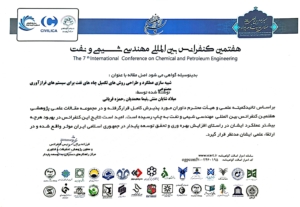
Publication Overview
-
Paper Title: Performance Simulation and Design of Oil Well Completion Methods for Artificial Lift Systems.
-
Conference: 7th International Conference on Oil, Gas, Petrochemical and HSE Engineering.
-
Date of Acceptance: 2022
-
Authors: Milad Shayanmanesh, Nima Mohammadian, Hamzeh Ghorbani.
-
Index Status: Full Paper Accepted & Indexed in CIVILICA.
The Strategic Value
“Delivering novel engineering strategies to extend the productive life of wells and optimize flow rates in mature oil fields.”
This research addresses a critical economic challenge: How to revitalize aging wells that have ceased natural flow, transforming dormant reserves into active production.
The Mission: Why This Research Matters
In the lifecycle of any oil field, there comes a point where natural reservoir pressure is no longer sufficient to lift hydrocarbons to the surface. The well suffers a “natural death,” leaving thousands of valuable barrels trapped underground.
My motivation for this research was fourfold:
-
Revitalizing Mature Fields: Many Iranian fields are in the second half of their lifecycle. I developed this study to provide precise engineering solutions to keep these wells alive and return them to the production cycle.
-
Strategic Technology Selection: Choosing between Electric Submersible Pumps (ESP), Sucker Rod Pumps (SRP), or Gas Lift is a high-cost strategic decision. My goal was to create a simulation model that predicts the optimal method based on specific fluid and rock properties, minimizing selection error.
-
Reducing OPEX & Downtime: A major pain point in Artificial Lift is the frequent failure of the completion string. I focused heavily on Mechanical Design—selecting the right materials and equipment layout—to maximize longevity and minimize costly workover operations.
-
Bridging Theory & Digital Twins: Leveraging my expertise in software like Petrel and ECLIPSE, I wanted to demonstrate how mathematical modeling can eliminate the financial risk of faulty completion designs before they are implemented in the field.
Technical Deep Dive
In this paper, I utilized advanced Production Engineering principles to analyze three key dimensions:
-
Dynamic Simulation: Modeled flow behavior under various Artificial Lift scenarios to accurately predict the potential flow rate.
-
Completion String Design: Engineered the selection and arrangement of downhole equipment to ensure compatibility with the chosen lift method.
-
Productivity Optimization: Developed models aimed at increasing the well’s Productivity Index (PI) over the long term.
The Proof: Scientific & Industrial Validation
-
Peer Review: After a rigorous review by the international scientific committee, this work was accepted as a Full Paper and published in the conference proceedings.
-
Industry Alignment: The results of this study are directly aligned with national goals for increasing productivity and achieving sustainable development in the Iranian oil industry.
-
Accessible Reference: Indexed in CIVILICA (The Reference Database for Iranian Conferences), making it available for citation by other researchers.
Verification
Authentication Code: ogpconf07-02460195
Publisher: Center for Achieving Sustainable Development (in collaboration with leading universities).
Download PDF Paper