

Research Publication: Intelligent Geomechanical Analysis of Salt Creep & Casing Damage
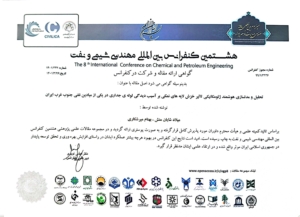
Publication Overview
-
Paper Title: Intelligent Geomechanical Analysis and Modeling of the Effect of Salt Layer Creep on Casing Damage.
-
Conference: 8th International Conference on Oil, Gas, Petrochemical and HSE Engineering.
-
Focus Area: Southwest Iranian Oil Fields (Gachsaran Formation).
-
Authors: Milad Shayanmanesh, Behnam Mirshekari.
-
Format: Poster Presentation & Full Paper Publication.
The Strategic Value
“Predicting the time-dependent behavior of salt formations to prevent structural failures and guarantee long-term well integrity.”
This research addresses one of the most complex challenges in drilling engineering: Drilling through mobile salt layers that can crush well casings like a soda can if not properly modeled.
The Mission: Why This Research Matters
Drilling in salt formations (such as the Gachsaran Formation in Southwest Iran) is notoriously high-risk. Due to a property known as “Creep,” salt layers behave like a viscous fluid over time, flowing into the wellbore under the immense pressure of overlying rock.
If this phenomenon is not accurately predicted, it leads to Pipe Sticking or, in catastrophic scenarios, Casing Collapse, resulting in billion-dollar financial losses and the total loss of the well.
My motivation for this intelligent modeling included:
-
Operational Reality Check: Having witnessed the challenges of drilling in these layers firsthand during my time at Rig 56 Fath (Ahvaz), I aimed to provide a model that could predict salt behavior to prevent national capital loss.
-
From Traditional to Intelligent: Classic geomechanical calculations are often slow and static. I utilized “Intelligent Modeling” to estimate casing damage with higher speed and precision than traditional methods.
-
Defining the “Golden Time”: A critical question for drillers is, “How much time do we have before the well closes in?” This research provides an engineering answer to determine the optimal drilling rate and Mud Weight required to counter creep pressure.
-
Long-term Integrity: Casing damage means the death of a well. This study focuses on understanding Casing-Rock Interaction to guarantee the mechanical lifespan of wells in shared and critical reservoirs.
Technical Deep Dive
In this paper, I integrated Geomechanics with Computational Intelligence to analyze:
-
Viscoplastic Behavior: Modeling how salt layers deform and flow over time under tectonic stress.
-
Casing-Rock Interaction: Estimating the specific load magnitude that creeping salt exerts on the casing string.
-
Predictive Accuracy: Using modern algorithms to minimize the error margins found in traditional calculations regarding casing deformation.
The Proof: Scientific & Industrial Validation
-
Conference Acceptance: Accepted and presented as a poster at one of the industry’s most respected scientific events.
-
Applied Value: The results are directly applicable to improving drilling performance and achieving sustainable development in Iran’s most challenging oil fields.
-
Scientific Indexing: Indexed in reputable scientific databases with a dedicated authentication code.
Verification
Authentication Code: ogpconf08-01300227
Scientific Approval: Signed by Dr. Abbas Nobakhti, Scientific Secretary of the Conference.
Download PDF Paper